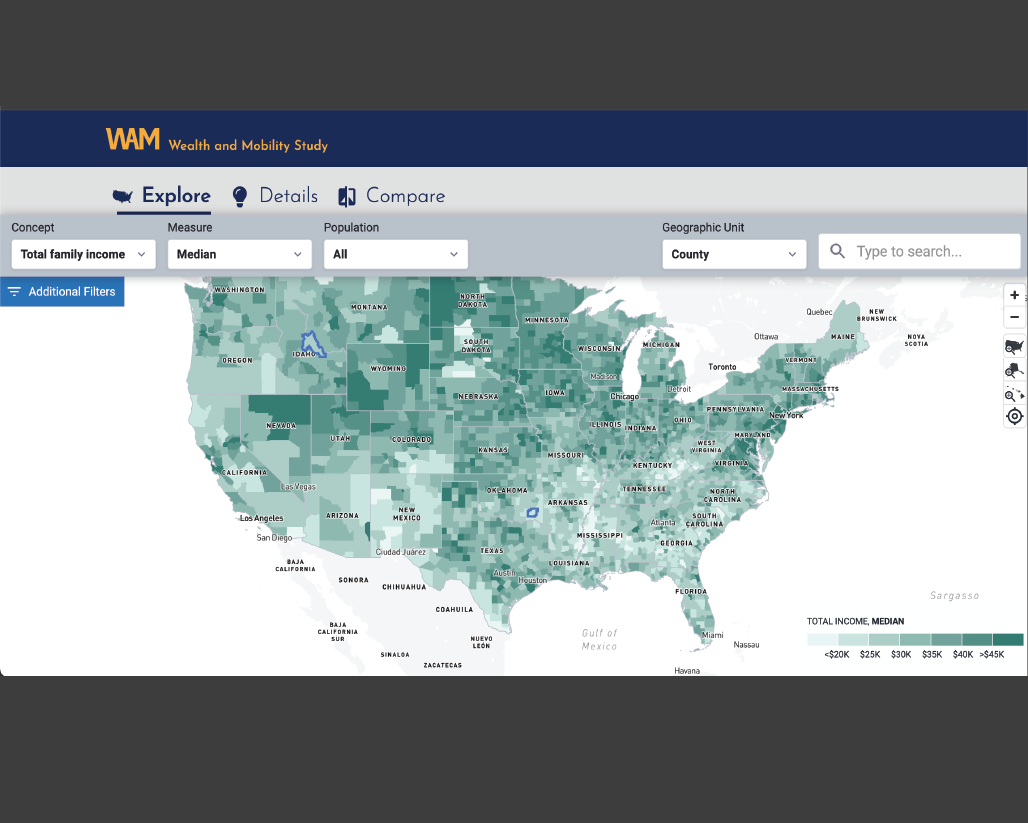
Through secure, direct access to IRS tax records, WAM is finalizing the creation of measures of the income and wealth holdings of the entire U.S. population and their linking across generations, extending pioneering work by Raj Chetty and collaborators, Emmanuel Saez and Gabriel Zucman, and others. WAM will publicly release a large, granular set of… Continue reading Wealth and Mobility Study (WAM)
Research Theme: Sustainability
Social Environment & Health
Since its inception in the early 1960s, the Social Environment and Health Program (SEH) has been a leader in the development of theory and research on the major role of psychosocial factors in the etiology and course of both mental and physical health and illness. Founded as a cross-disciplinary program, the program has been home to The… Continue reading Social Environment & Health
Characterizing upstream environmental, social, and economic determinants of health and their association with cancer-related health outcomes

This proposal seeks to characterize the upstream conditions identified by this framework in the persistent, current, and low poverty census tracts in the Karmanos Cancer Institute (KCI) catchment area and throughout Michigan by 1) developing a data resource of variables characterizing the upstream factors (social inequities & social justice; institutional environments; and economic, physical, social,… Continue reading Characterizing upstream environmental, social, and economic determinants of health and their association with cancer-related health outcomes
Landscapes of Population Health

Landscapes of Population Health (“Landscapes”) is an interdisciplinary research collective that includes historians, sociologists, psychologists, epidemiologists, and statisticians who bring their expertise in historical and contemporary racial violence and control, environmental justice, epigenomics, and population health to study the link between structural racism and population health. We bring together critical theories from the humanities and… Continue reading Landscapes of Population Health
Rollings,Kimberly

Trained in environmental psychology and architecture, Dr. Rollings’ research examines effects of the built and natural environment on physical and mental health, particularly among vulnerable populations at higher risk of poor health (low-income, children, seniors, unstably housed) within housing and neighborhood settings. Current work focuses on affordable and permanent supportive housing design and health. She… Continue reading Rollings,Kimberly
Sustainability Cultural Indicators Program (SCIP)

In collaboration with U-M’s renowned Graham Sustainability Institute, we implemented this comprehensive study designed to assess sustainability knowledge, behaviors, and attitudes across U-M students, faculty, and staff over time. This groundbreaking effort, known as the Sustainability Cultural Indicators Program (SCIP), is designed to inform educational programs and campus operations at the University, and is an… Continue reading Sustainability Cultural Indicators Program (SCIP)
A National Neighborhood Data Resource to Understand Inequities in the Health and Socioeconomic Impacts of COVID-19 in the United States

We are only beginning to clarify the ways the COVID-19 pandemic has resulted in substantial changes to American neighborhoods. There has been an excess of permanent business closures, particularly among small neighborhood businesses most vulnerable to social distancing, such as local barbershops and nail salons. COVID-19 outbreaks in late September 2021 caused 2,000 neighborhood schools… Continue reading A National Neighborhood Data Resource to Understand Inequities in the Health and Socioeconomic Impacts of COVID-19 in the United States
Examining the role of the neighborhood environment on muscle function in older adults

Poor muscle function is a pressing public health problem: half of all U.S. older adults meet criteria for muscle weakness. Poor muscle function, defined by low muscle strength and power, is a major risk factor for a host of negative health outcomes, including functional limitations, disability, and multimorbidity. Neighborhood characteristics predict functional limitations, disability, and… Continue reading Examining the role of the neighborhood environment on muscle function in older adults
Social Circumstances and Epigenomics Promoting Health in Three Countries

This project supports the analysis of existing social and epigenetic data for three countries and the development of longitudinal epigenetic data for three countries: the United States, Ireland, and the United Kingdome (Northern Ireland, specifically). The project will answer basic questions about how life circumstances in both childhood and adulthood affect epigenetic change and how… Continue reading Social Circumstances and Epigenomics Promoting Health in Three Countries
Assessing the Neuropsychological Benefits of Weatherization Programs

The homes of millions of older Americans do not provide adequate protection from extreme temperatures, due in large part to ‘energy poverty.’ Modifications to homes that increase energy efficiency and improve indoor temperatures may reduce the adverse neuropsychological health impacts of extreme temperatures. Indoor temperatures may impact sleep quality and short-term cognitive function, and high… Continue reading Assessing the Neuropsychological Benefits of Weatherization Programs