
Jody Schimmel Hyde, PhD, is a Research Scientist in the Survey Research Center (SRC) of the Institute for Social Research (ISR) at the University of Michigan (UM). She is a co-investigator and an associate director of the Health and Retirement Study. Dr. Schimmel Hyde’s research focuses on financial independence, employment, and public programs to support… Continue reading Jody Hyde
Research Theme: Economic Behavior
Wealth and Mobility Study (WAM)
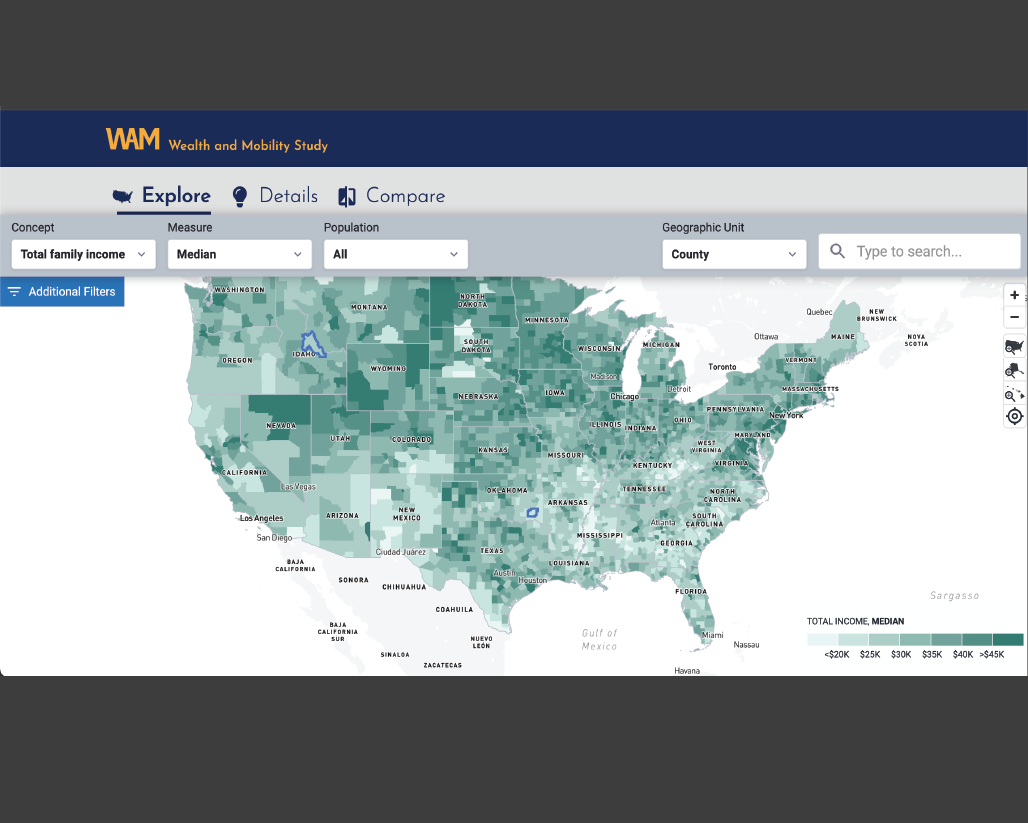
Through secure, direct access to IRS tax records, WAM is finalizing the creation of measures of the income and wealth holdings of the entire U.S. population and their linking across generations, extending pioneering work by Raj Chetty and collaborators, Emmanuel Saez and Gabriel Zucman, and others. WAM will publicly release a large, granular set of… Continue reading Wealth and Mobility Study (WAM)
Expanding the Industries of Ideas: Understanding the link between research investments, jobs, and skills

The immediate goal of the project is to identify what timely, local, actionable information tools can measure and describe the impact of NSF/TIP investments in critical and emerging technologies. The focus is documenting the impact of investments in Artificial Intelligence on jobs and skills so that stakeholder communities can proactively support the creation of high-wage,… Continue reading Expanding the Industries of Ideas: Understanding the link between research investments, jobs, and skills
Breakthroughs in science: The role of funding approaches and investment balance across Stokes’ quadrants

This project examines whether and how different models for funding and organizing research may relate to the disruptiveness of science. We pay special attention to an innovative model introduced by DARPA, as described by Dugan and Kaigham in 2013 and 2022, which is built on three key principles:
Crossley,Thomas Fraser

Thomas (Tom) Crossley is Research Professor and Director of the Panel Study for Income Dynamics (PSID). Professor Crossley’s research interests include household behavior (particularly consumption and saving behavior), financial security, and living standards; the design, collection and analysis of survey data; and economic measurement more broadly.
Re-Engineering Statistics using Economic Transactions (RESET)

This project aims to provide the architecture for re-engineering official economic statistics — literally to build key measurements such as GDP and consumer inflation from the ground up. The new measurement architecture offers internally consistent real output and inflation measures that adjust for product turnover and product quality change at scale. It builds up measures… Continue reading Re-Engineering Statistics using Economic Transactions (RESET)
Labriola,Joseph Mark

I am a Research Assistant Professor at the University of Michigan’s Survey Research Center. My research uses survey and administrative data to examine the roots of racial and socioeconomic inequalities in the contemporary United States. My current work primarily focuses on racial inequalities in housing and wealth. I have also published on the causes of… Continue reading Labriola,Joseph Mark
Joanne Hsu

Joanne Hsu (pronounced “shoo” ) is the Director of the monthly Surveys of Consumers, tracking leading economic indicators including consumer sentiment and expectations, and a Research Associate Professor at the Institute for Social Research at the University of Michigan. Dr. Hsu’s research is primarily in the fields of household finance, labor economics, public economics, and… Continue reading Joanne Hsu
Mitnik,Pablo A

Pablo Mitnik is an Assistant Research Scientist at the Stone Center for Inequality Dynamics. His research focuses on intergenerational mobility, economic inequality, labor markets, and statistical methods. His recent work has advanced new methodological approaches to measure mobility and inequality of opportunity and has studied these phenomena in the United States from a cross-national comparative… Continue reading Mitnik,Pablo A
Re-Inventing Measurement of Key Economic Indicators

The aims of this project is to provide improved measurement of retail trade. This project will pilot new approaches that have the potential to improve measurement of key economic indicators by increasing their accuracy, timeliness, and detail while potentially reducing the burden that statistical agencies place on businesses through surveys.