
ANN ARBOR – A new study based on body-worn camera footage capturing police-community interactions in Oakland, Calif., provides empirical evidence that police officer trainings can improve their interactions with the communities they serve. Findings published today in PNAS Nexus showed that police officers communicated more respectfully with drivers during traffic stops after they were trained… Continue reading Police body cams can measure effects of officer communication training
Project: Research Center for Group Dynamics
Robert Sellers to Give James S. Jackson Distinguished Lecture

The National Center for Institutional Diversity (NCID) and the Office of Diversity, Equity, and Inclusion (ODEI) will recognize Dr. Robert Sellers, the Charles D. Moody Collegiate Professor of Psychology, as the 2023 recipient of the James S. Jackson Distinguished Career Award for Diversity Scholarship. A distinguished lecture, panel discussions, and a reception on Oct. 28 will… Continue reading Robert Sellers to Give James S. Jackson Distinguished Lecture
Remembering Shirley Hatchett, Shaper of the First National Survey of Black Americans

Shirley Jean Hatchett, a survey researcher whose work yielded new insights about Black American attitudes and the sociology of race, died August 9, at 77. An early faculty member at the Program for Research on Black Americans (PRBA) at the University of Michigan Institute for Social Research, Dr. Hatchett made essential contributions to the program’s… Continue reading Remembering Shirley Hatchett, Shaper of the First National Survey of Black Americans
Article highlights three Indigenous approaches to youth suicide prevention

Contact: Jon Meerdink ([email protected]) ANN ARBOR — Suicide is commonly treated as a mental health issue, but Indigenous communities, specifically American Indian and Alaska Native (AI/AN), often approach the issue as a social problem — one associated with settler colonialism. Addressing the issue from that perspective is the focus of a recent paper, which examines… Continue reading Article highlights three Indigenous approaches to youth suicide prevention
How to Use ICPSR and NACDA

The MCUAAAR hosted webinar for HBCU partners Researchers often start with the arduous task of gathering data, but tapping into high-quality data sets that have already been collected can be a fast and invaluable way to survey the field, explore topics, and test ideas. By stewarding secondary data, ICPSR serves the purpose of providing social… Continue reading How to Use ICPSR and NACDA
RCGD to Explore Political Polarization

The U.S. is experiencing unprecedented levels of political polarization, especially in terms of affective polarization, or feelings of dislike and distrust towards members of the opposing political party. This winter, the Research Center for Group Dynamics at the Institute for Social Research is hosting an interdisciplinary Winter Seminar Series, free and open to the public,… Continue reading RCGD to Explore Political Polarization
David Dunning, on the Dunning-Kruger Effect

“The beauty and the terror of the internet,” social psychologist David Dunning tells interviewer David Edmonds in this Social Science Bites podcast, “is that there’s a lot of terrific information, but there’s also a lot of misinformation and sometimes outright fraud. People often don’t have the wherewithal to distinguish.” David Dunning, a professor of psychology at… Continue reading David Dunning, on the Dunning-Kruger Effect
ISR, partners conduct first national study of public libraries’ Black History Month programming

The University of Michigan Institute for Social Research (ISR)– in partnership with the Black Caucus of the American Library Association (BCALA) and the Public Library Association (PLA)– is embarking on a three-year project that will be the first systematic, national study to assess the content, scope, and factors influencing offerings of Black History Month programming… Continue reading ISR, partners conduct first national study of public libraries’ Black History Month programming
New funds for Family Safety Net pilot program to implement innovative approach to suicide prevention in northwest Alaska

Contact: Jon Meerdink ([email protected]) ANN ARBOR — After developing a brief family-focused suicide prevention intervention, new funding from the Kaiser Permanente Center for Gun Violence Research and Education will enable an implementation study to find out how to integrate the intervention into regular clinical practice. The Family Safety Net (FSN) program works to prevent deaths… Continue reading New funds for Family Safety Net pilot program to implement innovative approach to suicide prevention in northwest Alaska
Meet Kristine Ajrouch
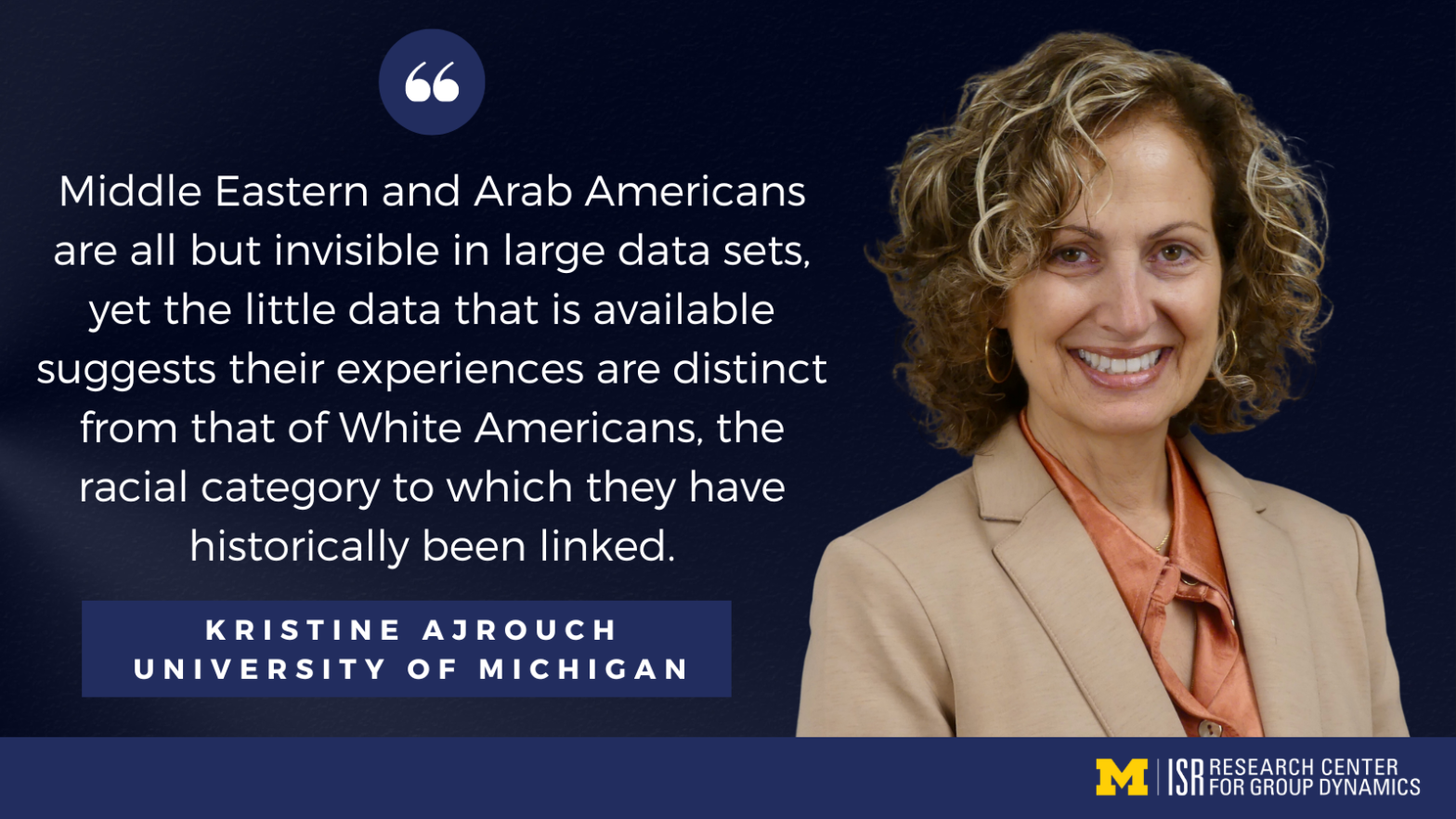
MCCFAD Co-Director joins RCGD as research professor, with new Healthy Aging grant addressing dementia-related stigma among MENA-Americans Growing up in an immigrant family, Kristine Ajrouch (Ahzh-ROOSH) has always been intrigued by people who immigrated – how they learned to think and talk in a new language. A native of Detroit, her maternal grandparents left Lebanon… Continue reading Meet Kristine Ajrouch