The World Mental Health initiative (WMH) is one of the most influential resources for global research on mental health. The key ingredient: A general population survey instrument carefully designed and consistently implemented to generate diagnostic measures with high clinical validity across languages and cultures.
The unique impact: Valid measures of mental health and mental disorder prevalence rates – as well as important contextual data such as exposure to related experiences and treatment services — in the entire general population of a country or region. This approach surpasses simple screening measures for mental health/illness by identifying individuals who have suffered from symptoms and consequences of a mental disorder, even if they are not suffering at the time of the interview. It also surpasses clinical assessment of mental illness by including a scientifically selected sample of the country/region and applying the same measurement protocol – regardless of whether the individuals have sought or obtained treatment.
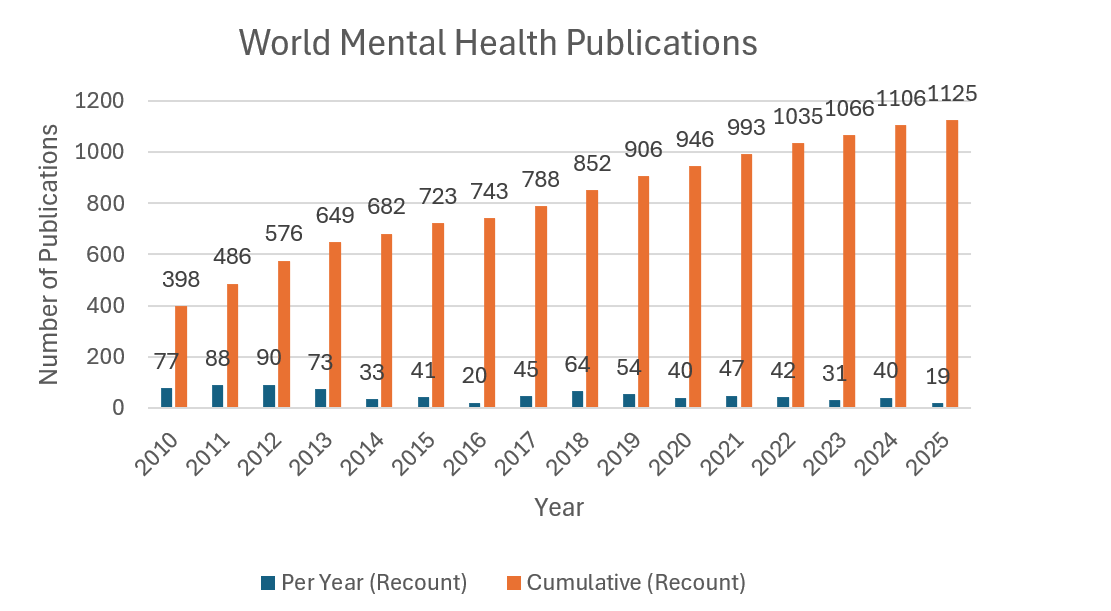
These benefits have made the carefully coordinated World Mental Health surveys among the most scientifically influential social science projects of this century. Considering the surveys collected before 2015 – using the measures and diagnoses calibrated to the DSM-IV – the data have been used for more than 1,100 publications, with more added every year (see Figure 1).
This science is a key ingredient to advancing our ability to identify:
- The true population prevalence (lifetime, 12-month, and current) of mental disorders;
- The risk factors, comorbidity, and consequences of disorders;
- The use of treatment and barriers to treatment for these illnesses; and
- The potential for interventions to minimize mental disorders.
Carefully designed to produce consistent measurement across a wide range of people, languages, and settings, the World Mental Health surveys provide a fundamental tool for discovering differences across people and place that reveal opportunities to reduce and manage mental illness worldwide. Visit the World Mental Health Survey Initiative for more details about the background of the Consortium..
The Transition to the University of Michigan
The creator of these tools and founder of the World Mental Health survey initiative – Ronald Kessler – was a University of Michigan professor in Sociology and the Survey Research Center early in his career. He moved to Harvard in 1996, collaborated with the World Health Organization to launch the first generation of WMH surveys in 2000, and directed the consortium from Harvard’s School of Public Health. Since the beginning, the global survey data collection coordination, training, and production support remained at Michigan’s Survey Research Center. Now, as Kessler retires from directing the consortium, he is passing it back to Michigan, to the new generation Co-Directors Stephanie Chardoul and William Axinn.
Axinn is the inaugural director of the new International Research Hub at the Institute for Social Research, co-director of the Chitwan Valley Family Study in Nepal, and interim director of the International Policy Center at the Ford School of Public Policy. Axinn began attending the consortium annual meetings in 2009 to integrate portions of the survey into research in Nepal. The scientific rigor and social impact of the World Mental Health surveys motivated him to become continuously more involved ever since.
The Transition will Take Time, Effort, and Support
The scope and scale of this transition is vast. Not only are we moving all current World Mental Health coordination activities to the University of Michigan, but we are expanding the scope and creating a secure data enclave to facilitate the sharing of and access to all collected WMH DSM-5 data. Five countries/regions have completed the new generation of data collection. Five more are in the process of launching and conducting data collection. Eight others are planning and fundraising to launch new data collection. These countries span every populated continent around the world.
Transitioning this work from Harvard to Michigan will not be quick, easy, or free. We welcome your support! To contact us, email Stephanie Chardoul: [email protected].