ANN ARBOR — Using data from the Health and Retirement Study (HRS), researchers at the University of Michigan and Florida State University have developed a new, 10-item health survey to assess a variety of health conditions.
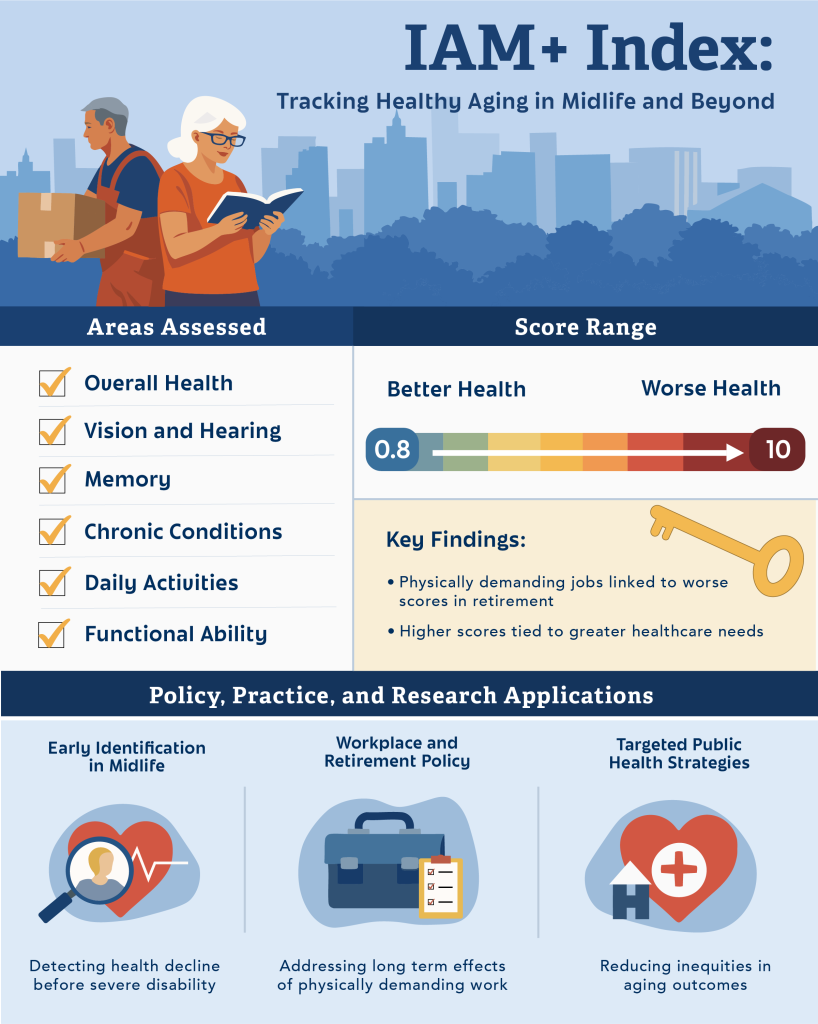
The IAM+ index assesses numerous areas of an individual’s health, including overall health and fitness, eyesight, hearing, and memory. Each domain is scored on a scale ranging from 0.8 to 10, with higher scores indicating a poorer outcome. Michigan’s Amanda Sonnega, a research scientist at U-M’s Institute for Social Research (ISR), assisted in the development of the index. She says it fills in the gaps left by other, similar assessment tools.
“Too often, other measures focus on single aspects of a person’s health, or focus too much on advanced disability. These measures can miss early signs of decline,” she said. “And since the IAM+ index is multidimensional and accessible, it can identify issues before severe disability sets in, especially since it relies only on publicly available public survey data.”
HRS data is collected via survey from adults in the United States aged 51 and older. That data, coupled with insights from IAM+, should help researchers better understand health trends among older Americans. For instance, Sonnega says the index already helps point out ways in which people who have worked physically demanding jobs may struggle as they age.
“Post-retirement, people who worked in strenuous roles showed worse scores on IAM+ index than their peers, which can lead to health issues later in life. Over a two-decade interval, higher scores were linked to greater healthcare needs for all individuals,” she said.
The IAM+ index has been shown to work for both men and women and accounts for differences in race and education. It is intended to provide insight into ways that can help people of all ages and backgrounds as they age. Applications could include early intervention in response to declining health in middle age, establishment of new workplace policies to create safe, supportive work environments for older workers, retirement planning, and general public health support.
For more information in the index and its development, see this release from researchers at Florida State University. For more on the IAM+ index, see the paper “Predicting active and productive engagement: introducing the index of aging in midlife and beyond.”