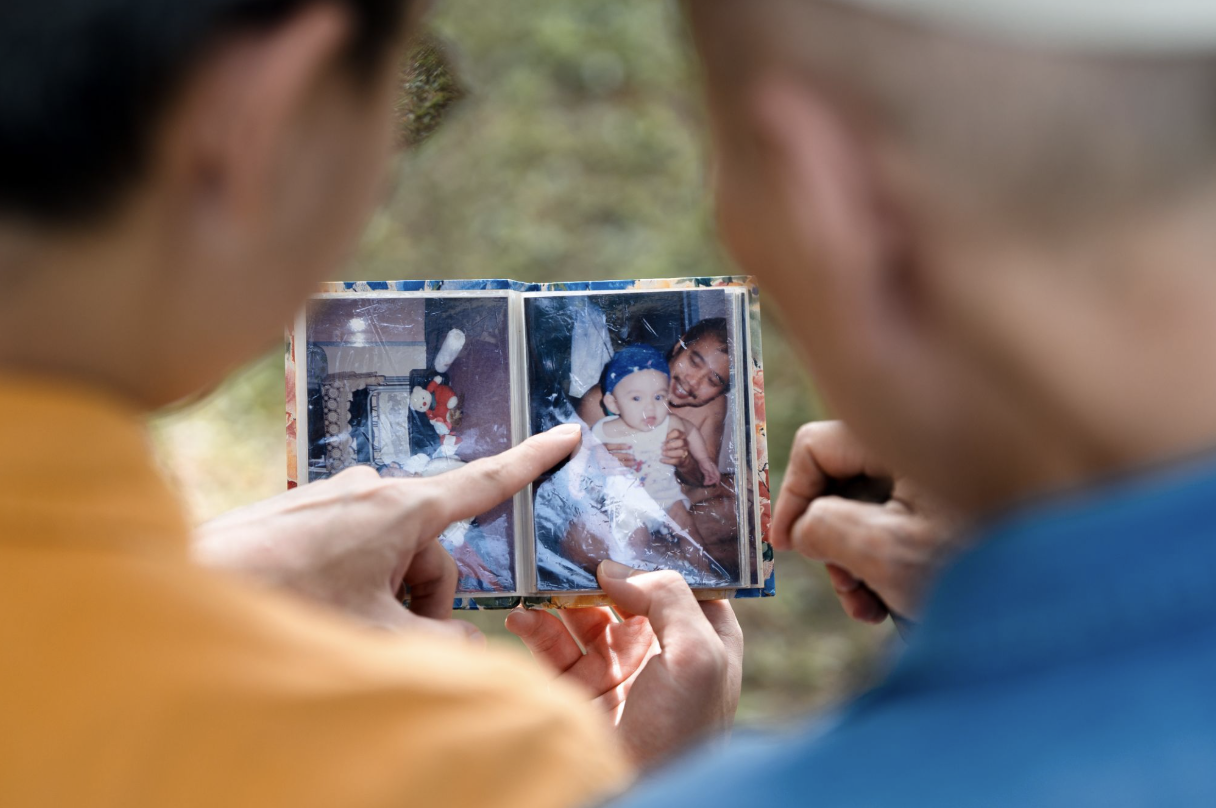
Could sharing a family photo with an employer make workplace mistreatment less likely to occur?
Researchers studying Filipino domestic workers, in collaboration with the Philippine government through the Overseas Workers Welfare Administration, found that small gestures– providing a small gift of dried mangos and showing a family photo to new employers overseas– reduced mistreatment, increased job satisfaction, and increased the likelihood of extending work contracts.
The study, “Picture This: Social Distance and the Mistreatment of Migrant Workers,” was recently published in the Journal of Political Economy Microeconomics.
“Migrant workers are vulnerable to mistreatment, but difficult to protect through policy approaches because those are hard to enact and enforce,” said University of Michigan economist Dean Yang, Professor in the Department of Economics and the Gerald R. Ford School of Public Policy, and Research Professor at the Population Studies Center at the Institute for Social Research. “Our intervention is simple. We hypothesized that when migrant workers show a family photo to their employers, this would reduce mistreatment of workers by employers due to a reduced perception of social distance from the worker.”
Some 11.5 million international workers are employed as domestic workers, typically tasked with household cleaning, cooking, and family care. About 3 in 4 of these are women.
International labor migration is a major phenomenon of the Philippines; at the start of the study, 2.4 million Filipinos were working overseas (out of a population of 100 million) and domestic work was the most common occupation for female Filipino migrants. Finding work through recruitment agencies, workers from the Philippines typically migrate to Asia and the Middle East, often destined for Saudi Arabia or Hong Kong.
All workers receive mandatory training, prior to departure, and the researchers partnered with the Overseas Workers Welfare Administration in the Philippines to conduct their intervention to help some 2,000 Filipino women newly departing alone for work in Saudi Arabia and Hong Kong. Study participants assigned to the treatment group were instructed to travel with a small gift for new employers– a Philippine specialty of dried mango worth about US $2– which would serve as an icebreaker and an opportunity to share a family photo. The intervention drew on the Filipino tradition of pasalubong– bringing a small gift when returning from a journey..
Building on evidence from behavioral economics, the researchers predicted the simple gesture might reduce mistreatment of Filipino overseas domestic workers by their employers.
The study’s novel approach was to causally manipulate social distance in order to improve relations between employers and employees, Yang said.
The researchers’ previous survey data showed that mistreatment from household employers was “nontrivial,” by measures including reports of sexual harassment, physical violence, and not having a weekly rest day. Collecting these data was itself a major undertaking; domestic workers are difficult to reach and sensitive issues such as mistreatment require careful attention to privacy and safety.
“We found that the intervention improved the treatment of domestic workers, by several measures, up to two years after the start of employment,” said Yang. “It led workers to report less mistreatment in areas like verbal and physical abuse, working conditions, and timeliness of wage payments. The workers reported higher satisfaction in their relationships with employers and were more likely to remain working with their employer.”
The intervention affected different types of mistreatment in Saudi Arabia and Hong Kong, and had particular effect on employers who had not communicated with the domestic workers prior to their departure.
In an additional experiment using an online dictator game– a widely used behavioral economics test in which subjects decide whether and how to share sums of money– the researchers concluded it was the family photo alone that was the sole driver of increased employer generosity.
The findings have ethical and economic implications: They demonstrate a nearly cost-free approach that can improve migrants’ welfare.
“This intervention is not intended to shift responsibility for preventing abuse onto migrant workers themselves,” said researcher Vojtěch Bartoš. “Workplace mistreatment reflects structural power imbalances and requires robust legal protections and enforcement in destination countries. But these reforms are often slow to enact and difficult to enforce, especially since migrant workers typically lack political representation in host countries. The intervention offers workers a tool that can improve outcomes in the near term while broader legal and institutional reforms remain essential.”
“This is an intervention that could be applied broadly and directly by migrants themselves,” said Yang, whose collaborators also included Toman Barsbai, Victoria Licuanan, Andreas Steinmayr, and Erwin Tiongson. “It isn’t a cure-all that will work in all settings, but it shows that a simple intervention can go a long way to reduce distance and build empathy in human relationships.”
Contact: Tevah Platt, communications manager for the Population Studies Center