ANN ARBOR — The Berlin Philharmonic makes beautiful music, but it takes more than a group of skilled musicians to bring together a great performance. In fact, much of the work that goes into a stirring rendition of a classic piece of music has less to do with the musicians than the organization that supports them.
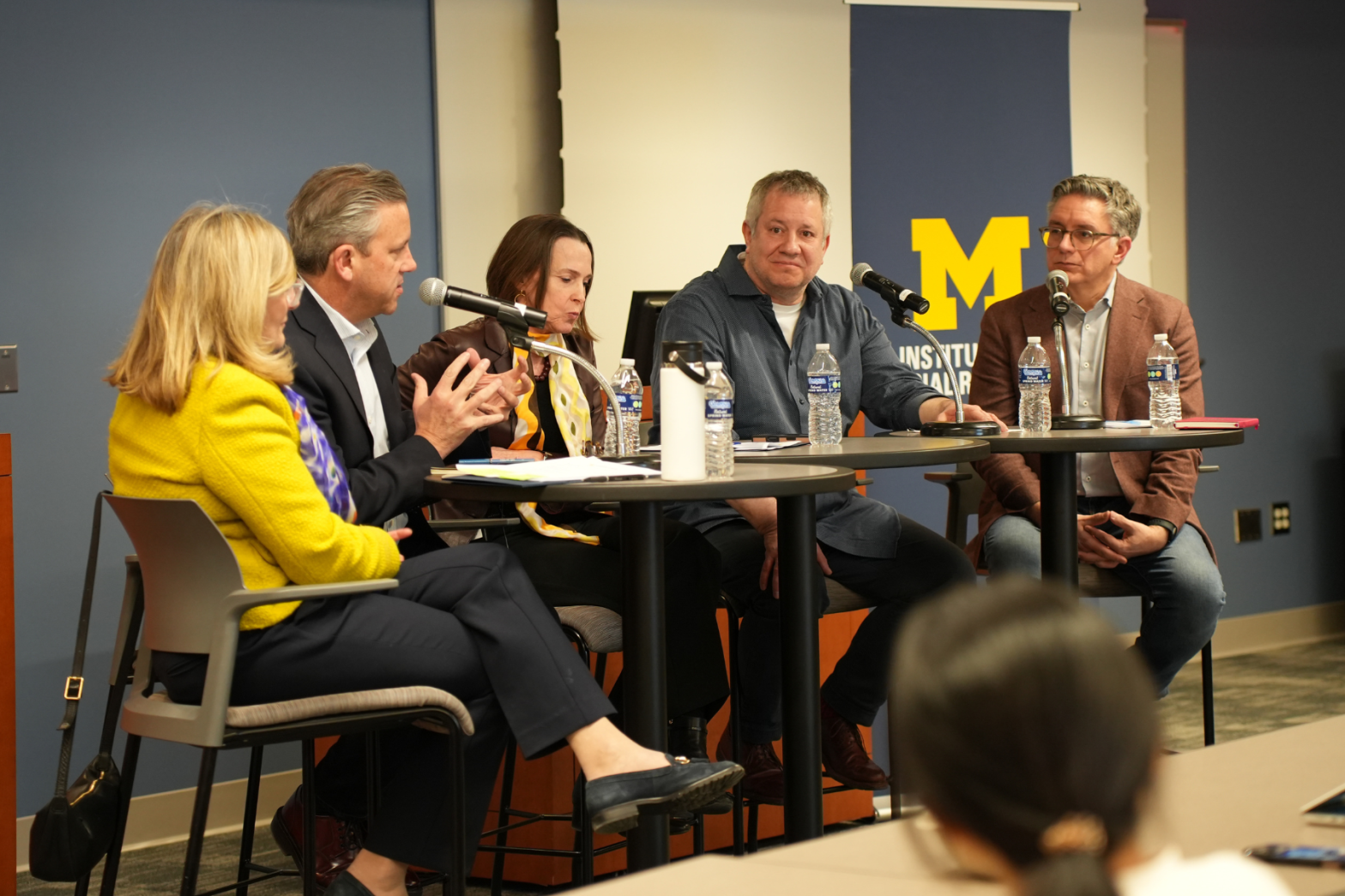
The structure of that organization was at the center of a panel discussion at the Institute for Social Research (ISR) on February 4, 2026 as members of ISR, the broader Michigan musical and academic community, and the Berlin Philharmonic discussed ways the orchestra structures itself to bring the most out of both its musicians and its non-musical support staff in addition to exploring how that differs from other organizational structures.
Kate Cagney, director of ISR, moderated the panel, which included the following contributors:
- Stefan Dohr, principal horn, Berlin Philharmonic
- Gretchen Spreitzer, Keith E. and Valerie J. Alessi Professor of Business Administration, Ross School of Business
- Matthew VanBesien, president, University Musical Society
- Mark Clague, executive director, U-M Arts Initiative
Dohr explained that the Berlin Philharmonic’s structure and operations differ in important ways from American orchestras. The Philharmonic’s 130 musicians and approximately 190 other support staff are organized into a self-governing public foundation which manages and organizes its own operations.
The Berliner Philharmoniker Foundation is managed by a four-member executive board, which is supported by several other committees. Each of these bodies is selected by vote by members of the orchestra as a whole, which Dohr said is a core function of the orchestra’s regular meetings. These meetings serve the dual function of conducting business and keeping open lines of communication to every level of the organization.
“The orchestra, with 130 members, meets four to five times a year and decides a lot,” Dohr said. “And [because the whole orchestra is there] if they’re deciding something, then nobody can say ‘this isn’t happening.’”
This is a marked difference from how most orchestras conduct business, according to VanBesien, who has worked as the administrative head of three different orchestras both in the United States and in Australia.
“Most orchestras here in the United States developed what would be described as a much more corporate governance model, largely in the beginning of the 20th century,” he said. “That also coincided with how orchestras get their funding, and that’s primarily from donations.”
Clague observed that the Berlin model could create an environment where the orchestra itself has a different relationship with the big questions that face an orchestra, like fundraising and other decisions typically left to outside committees.
“One of the really interesting things about Berlin is the sort of closeness that the musicians have to the decisions and issues and sort of threats and opportunities that are facing the organization,” he said. “And they participate in that decision making.”
This structure, according to Spreitzer, enables the Berlin Philharmonic to be flexible when addressing organizational tension.
“One big tension that I hear about and that is very common is the tension between what the organization needs and what the individuals in the organization need and want,” she said. “And often in modern organizations, those things are in conflict with each other, and so you see things swing one way or another, but positive organizations are ones that can hold that tension in place to recognize those different needs.”
The panel was the latest part of a multi-year collaboration between ISR and the Berlin Philharmonic. ISR previously hosted members of the Berlin Philharmonic for a visit and panel discussion in November 2024.