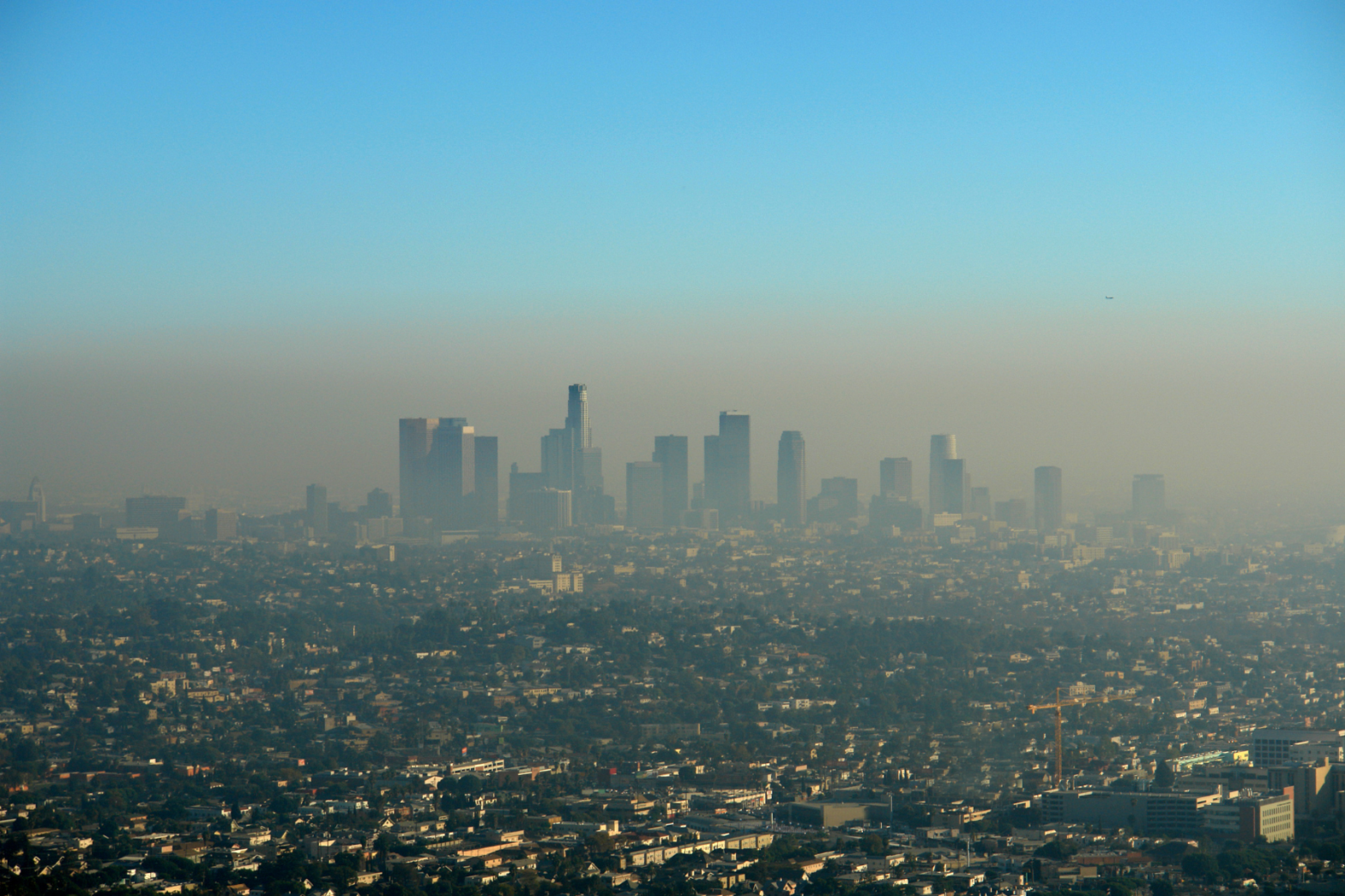
ANN ARBOR — People forced to breathe polluted air may be shortening their lives one breath at a time.
People living within a 25-kilometer high-pollution buffer zone lived about four fewer years on average than their peers in less polluted areas according to a new study led by Reed DeAngelis of Michigan’s Institute for Social Research (ISR).
In “Industrial Air Toxicant Exposure and Individual Mortality: Evidence from the Americans’ Changing Lives Cohort, 1986–2019,” DeAngelis, an assistant research scientist in the Landscapes of Population Health program at ISR’s Survey Research Center, analyzed more than 30 years of data from people in the Americans’ Changing Lives (ACL) Cohort, following them from 1986 through 2019.
In the paper, DeAngelis and colleagues measured industrial air pollution in different spatial buffers surrounding the homes of survey respondents, using those measures to predict their time of death. And on average, even people exposed to relatively low levels of industrial air pollution lived for one to two years fewer than people exposed to less pollution. Those with heavy pollution exposure fared the worst.
“That gap widened out to about four years if we considered pollution exposures within large buffer areas closer to the size of cities. People who lived in those areas over the study period lived four fewer years on average compared to people who lived in similar buffers with little to no pollution.”
DeAngelis and co-authors sourced their pollution data from the Environmental Protection Agency (EPA), which maintains information on certain industries that release toxins into the environment in a report called the Toxics Release Inventory (TRI). Using modeled estimates based off local climate and geography, DeAngelis was able to look at a list of about 300 chemicals that could be polluting a given environment, weighted by their toxicity levels.
Combined with five different sized buffer zones, ranging from roughly a neighborhood size to greater than a large city, he was able to model proxies of pollution exposure for ACL respondents across their adult life course .
Geography was just one factor connected to pollution exposure. “We also wanted to see if different groups of people were affected differently by air pollution, the idea being that certain segments of the population may be experiencing other stressors that interact with air pollution exposure to compound the health effects of pollution,” DeAngelis said. Indeed, the study found that air pollution exposure appeared even more harmful for the health of ACL respondents who identified as Black or lived in high poverty contexts.
DeAngelis acknowledges that air pollution being a negative factor for American society may not be a revolutionary finding. After all, links between industrial air pollution and health and mortality have been well established. However, the paper does reinforce one key finding: there may be no safe amount of air pollution. Any amount appears dangerous to a person’s health.
“Historically, the EPA has set higher thresholds than some researchers would say is safe, and there’s debate on what’s a safe threshold of air pollution exposure for human beings,” DeAngelis said. “Our paper corroborates that there may not be a safe threshold. Even really low levels of exposure appear to cause health problems.”“Industrial Air Toxicant Exposure and Individual Mortality: Evidence from the Americans’ Changing Lives Cohort, 1986–2019” is available now in full on ResearchGate.