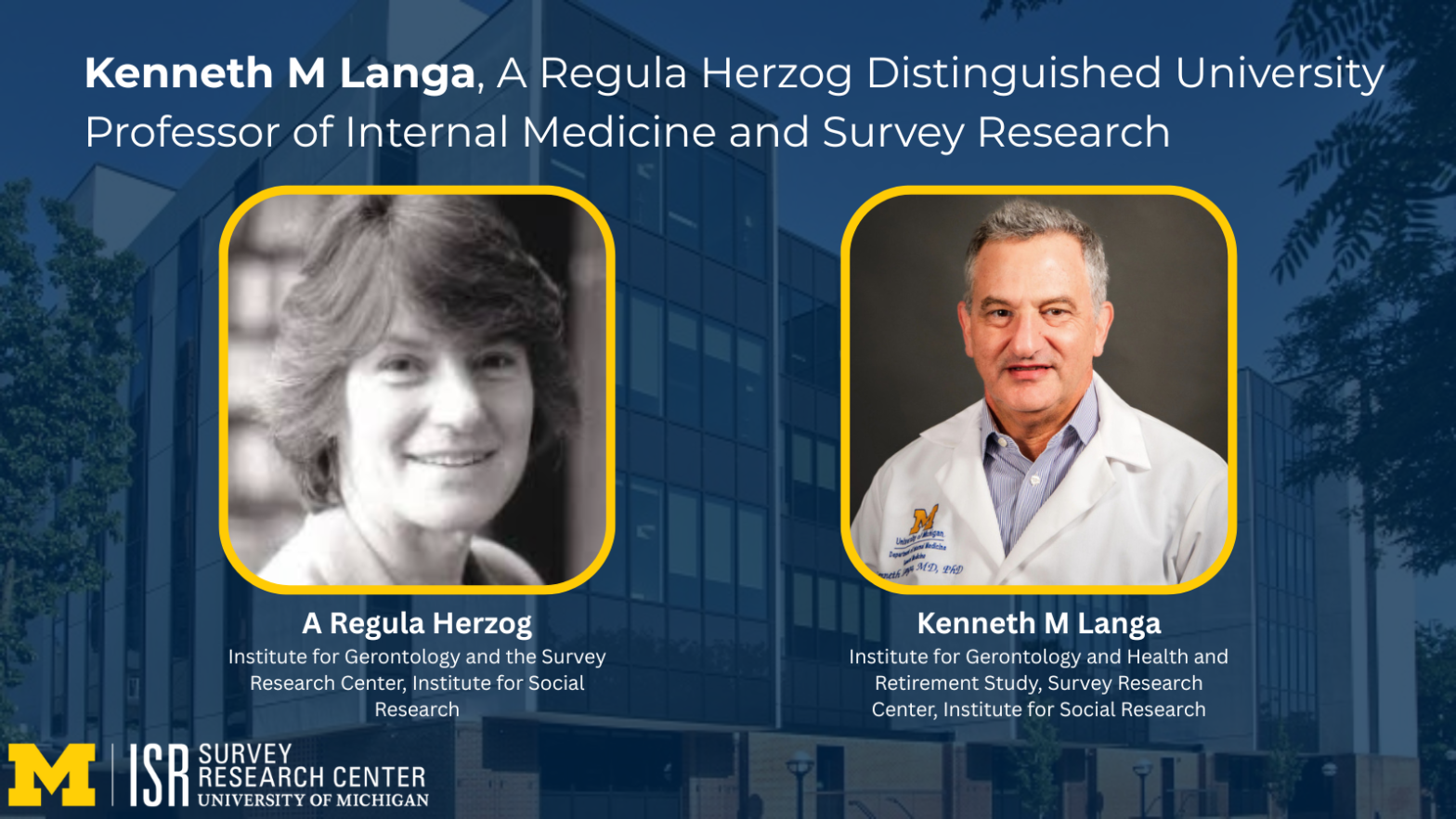
The UM Board of Regents honored Kenneth M. Langa with a Distinguished University Professorship. The professorships bear the name chosen by the appointed professor in consultation with their dean. Dr. Langa chose A. Regula Herzog, who was a senior research scientist at the Institute for Gerontology and the Survey Research Center of the Institute for Social Research, as well as an adjunct professor of psychology. At the time of her death in 2002, Dr. Herzog’s colleagues said her research would have a lasting impact, especially her work on the Health and Retirement Study, the largest and most influential study of aging in the U.S.
Kenneth M. Langa’s research has shaped our understanding of aging, cognitive impairment, and dementia. He has served as the associate director and now co-director of the Health and Retirement Study. His many honors include election to the National Academy of Medicine and awards for outstanding mentorship.
How did you become interested in aging and cognitive impairment?
I did a joint MD-PhD program at the University of Chicago (PhD in Public Policy), and as the result of a class I took there, became interested in the question of how to “value” activities that aren’t typically provided by “the market,” with a common and classic example being the provision of unpaid or “informal” care to family members, such as taking care of kids or elderly parents. Dementia is the condition of aging that leads to the largest need for informal care for older adults.
Did Regula Herzog bring you to the Survey Research Center? How did you meet her?
I moved to UM from the U of Chicago in 1994 to do my internal medicine residency training, and then I stayed on for two more years as a Robert Wood Johnson Clinical Scholar. Bob Willis, the PI of the Health and Retirement Study (HRS) at the time had been on my dissertation committee at the U of Chicago and moved to UM in 1996 to take over leadership of the HRS. We re-connected while I was an RWJ Clinical Scholar and he invited me over to ISR to talk about the study and whether I might want to do some research with the HRS data. I had a single one-hour meeting with Bob Willis, Bill Rodgers, and Regula Herzog in 1997 which, quite literally, set me off on a 28-year path that has defined my research career and work on the HRS right up until today. The NIA had asked the HRS team to develop a study of dementia within the HRS, and Regula led that effort which resulted in the Aging, Demographics, and Memory Study (ADAMS). Regula invited me to help with the writing of the ADAMS grant, and also mentored me on the use of the HRS data, including studying the unique data on informal care that was collected in the HRS right from the start of the study.
What impact did she have on your research and career?
Regula was a wonderful mentor and collaborator who helped me write my first NIA grant, a Career Development Award, to study dementia in the HRS and she was my primary mentor on that project. Sadly, Regula died in 2002, just as the ADAMS project was being launched, which was a huge loss for me, the HRS team, and for the field of survey research on older adults, in general. Regula was just a great colleague and person, who was extremely kind and generous to the many junior faculty with whom she worked, including me.
What lessons did you learn from her and what influence does she continue to have on both your scholarship and on you personally?
Regula was a very hard-working, careful, and meticulous researcher who checked and re-checked her work multiple times to make sure it was sound, and she was also extremely organized when leading large projects (her Swiss heritage was often cited as the source of her impressive organization skills). At the same time, she had a wonderful sense of humor, laugh, and smile that endeared her to her colleagues, including me. I’ve tried to emulate Regula’s “business-like” manner for getting projects and good science done, but I’ve also tried to create teams that laugh, have fun, and enjoy time outside of work, as well, just like Regula did.