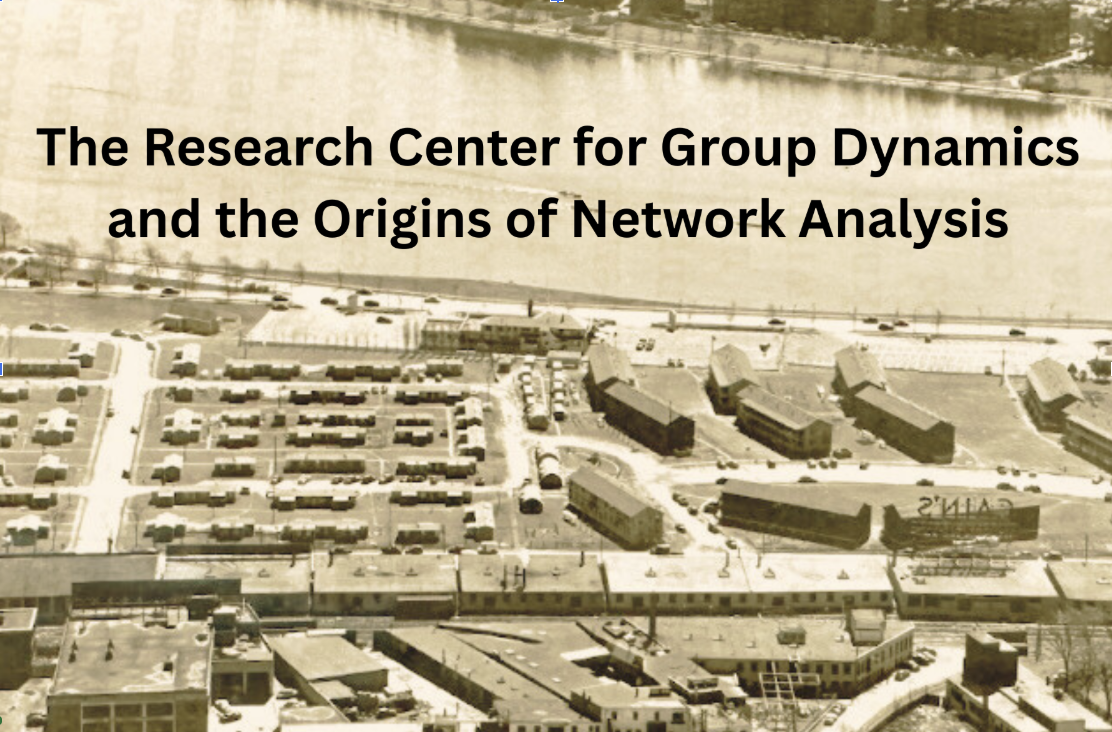
Postwar Researchers at U-M made groundbreaking discoveries around how relationships work that continue to help us understand society today
“A told B, and B told C, I’ll meet you at the top of a coconut tree.”
The opening lines of a classic children’s verse deliver a bouncy lesson in letters to tiny learners – but they hold a deeper truth about human existence: Our behavior as individuals depends hugely on chains of influence and the encounters that place us in social context.
The Social Network
Any system with interacting components can be described as a “network,” and these webs, often pictured as “nodes” and “edges” (dots and connecting lines), sprawl fractally around and within us.
Advances in computing have expanded our ability to study networks over the past half-century, unlocking valuable insights into nature and biology, marketing and economics, computing and information sharing, and more. Social scientists in particular take an interest in “social networks,” the type of network that specifically links people, which can show us patterns in how we relate.
“The ultimate goal in studying networks is to better understand the behavior of the systems they represent,” writes University of Michigan’s Anatol Rapoport Distinguished University Professor of Physics, Mark Newman, in his textbook, Networks: An Introduction. “For instance, we study social networks to better understand the nature of social interactions and their implications for human experience, commerce, the spread of diseases, and the structure of society.”
Origins of Social Network Analysis
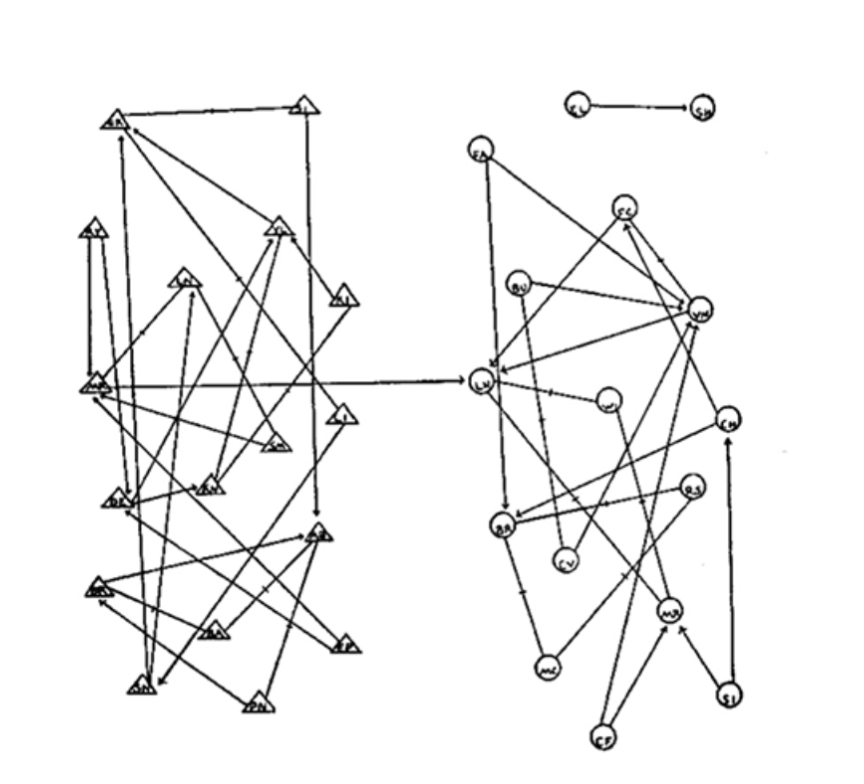
The psychiatrist Jacob Moreno is widely regarded as the founder of social network analysis. In the 1930s, Moreno and Helen Hall Jennings developed “sociometry,” a quantitative method for measuring social relationships. Moreno’s node-and-edge figures, which he called “sociograms,” made relational dynamics within groups– such as gender-segregated friendships in a classroom, for example– visually obvious. A reproduction of Moreno’s hand-drawn figure below, from the American Society of Group Psychotherapy and Psychodrama, shows friendship patterns among boys (triangles) and girls (circles) in a fourth-grade classroom.
But the foundations of network analysis took meaningful shape at the Research Center for Group Dynamics (RCGD) in the late 1940s, where several generations of scholars made powerful and lasting contributions to the study of social dynamics among groups.
The Research Center for Group Dynamics
RCGD was founded in the wake of World War II at the Massachusetts Institute of Technology with the vision of grounding technological development in an understanding of human behavior. The center moved from MIT to the University of Michigan after the death of its founder, Kurt Lewin, and joined the Survey Research Center in 1949 to form Michigan’s Institute for Social Research, now the largest academic social science research and survey organization in the world.
Like Moreno, Lewin was a refugee from Hitler’s Europe whose interest in social dynamics was grounded in the Gestalt psychology movement he had studied in Germany. (The social science seminar series hosted weekly at RCGD, open to the public, was first organized by Lewin in Berlin, and these continue today in their centennial). Lewin inaugurated modern social psychology with an approach to social science that focused on “field theory,” studying the totality of an individual’s situation, rather than isolated behaviors, to address real-world problems.
In a series of works, Lewin’s students and successors at RCGD connected Lewin’s field theory to graph theory, the branch of mathematics that models pairwise relationships. They developed key concepts, such as “centrality” and “cliques,” to describe nodes with many connections and cohesive clusters in which all nodes are connected, which play important roles in a network.
Returning back to the alphabet rhyme: Consider D– a well-connected node in that network of letters who brings E, F, and G to the race to the coconut tree. An important node in the spread of information, today we’d refer to “D” as an influencer. The march continues in clusters: Q,R,S! And T,U,V! And so on.
But while we can easily see “central” nodes– hubs with many spokes– on a sociogram, the study of chains of influence and the patterns of interconnections within groups– particularly the number of paths between nodes – required a new mathematical model. The innovation of the adjacency matrix, widely used today, allowed researchers to analyze indirect or multi-stage relationships such as the flow of information in the example of “A told B, and B told C.”
Human Factors in Housing
Enter the landmark study, Social Pressures in Informal Groups: A Study of Human Factors in Housing, by RCGD’s Leon Festinger, Stanley Schachter, and Kurt Back. Funded by a grant to answer practical questions about housing, Lewin’s successors used a natural experiment to compare group formation, group influence, and member deviation in two student housing complexes at MIT: the Westgate complex, arranged in horse-shoe formations around courtyards, and the Westgate West apartment buildings next door. (All figures and photographs of the housing layouts, c. 1946, are from the “Architecture and Group Membership: Social Issues, 1951” Folder, Box 3, Leon Festinger Papers, Bentley Historical Library, University of Michigan).
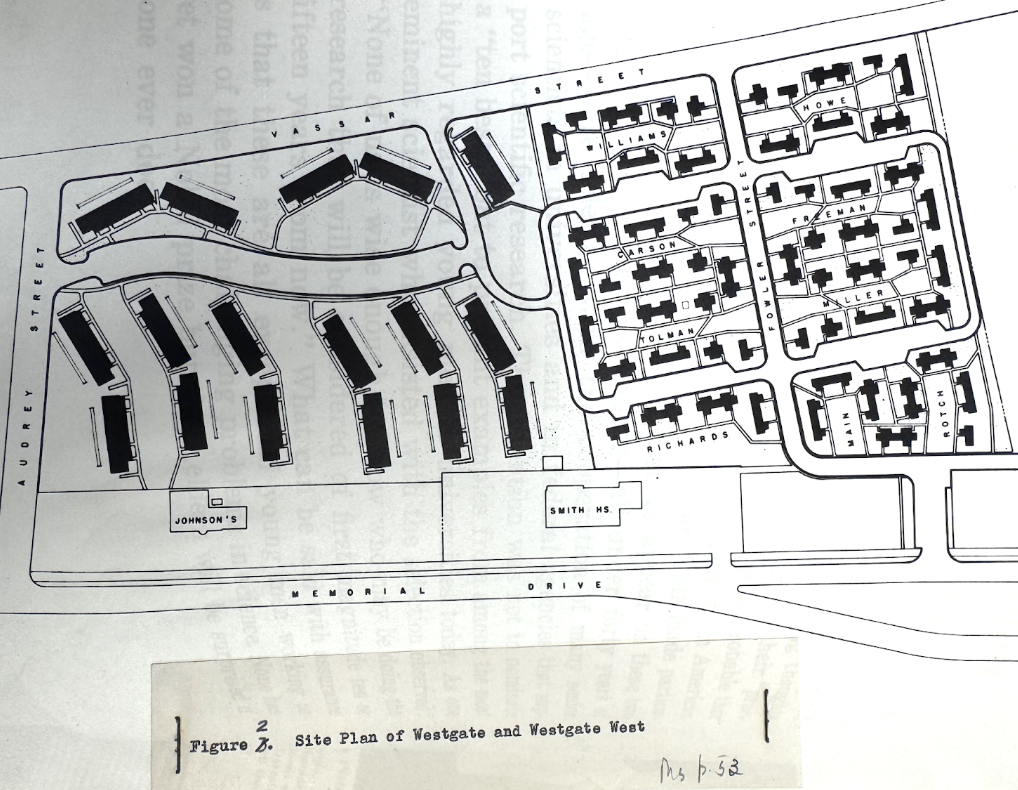
The authors reported their most striking finding as the dependence of friendship formation on the mere physical arrangement of the houses: “People who lived close to one another became friendly with each other, while people who lived far apart did not. Mere ‘accidents’ of where a path went or whose doorway a staircase passed were major determinants of who became friends within this community.”
Matrix Multiplication
This insight– that proximity or “mere exposure” is a major determinant of how our lives unfold– was groundbreaking. So too was the realization that such effects could be studied with the application of matrix multiplication to sociometry.
For this, Festinger enlisted the help of R. Duncan Luce, a graduate student in mathematics at MIT who would later be awarded the National Medal of Science, and mechanical engineer Albert Perry. Their innovation made it possible to calculate the number of paths between nodes and to measure the depth of cliques within social groups using a trick of linear algebra.
“[We were able] to develop a new method of analyzing the structure of groups and relating this structure to the cohesiveness of the group and the communication pattern within it,” wrote Festinger et al. “…By matrix multiplication, it is possible to determine in simple, non-trial-and-error fashion all the chains by which influence or communication might spread through a group.”
In an adjacency matrix, interactions among 12 individuals are laid out in a 12-by-12 grid, with one row and column for each person. Zeros and ones on the grid indicate where there are connections between each pairing, with zeros necessarily falling along the diagonal where A would adjoin with A, B with B, and so on. When the sociometric pattern is presented in this matrix form, analysis of some aspects of the group structure– including indirect, long-term, and multi-stage relationships– can be performed simply by squaring, cubing, or further multiplying the matrix by itself. For example, the authors of the housing study multiplied the matrix by itself x number of times to determine (along the diagonal) the number of cliques of the size x that each individual was a part.
“Just doing simple mathematical operations, this analysis lets you learn about the structure of friendship patterns,” said Rich Gonzalez, the current director of RCGD, who has advanced methods for the study of dyadic, or two-way relationships. “There’s fancier stuff now that people do, but that’s the foundation of network analysis.”
Chains of Connection
This form of network analysis is widely used today to inform algorithms and determine shortest paths in networks, thereby speeding up computation and travel. It allows researchers to study “small world effects,” or to calculate the mean number of connections required to connect any two people, even in vast networks; the rough result is now commonly known as “six degrees of separation.”
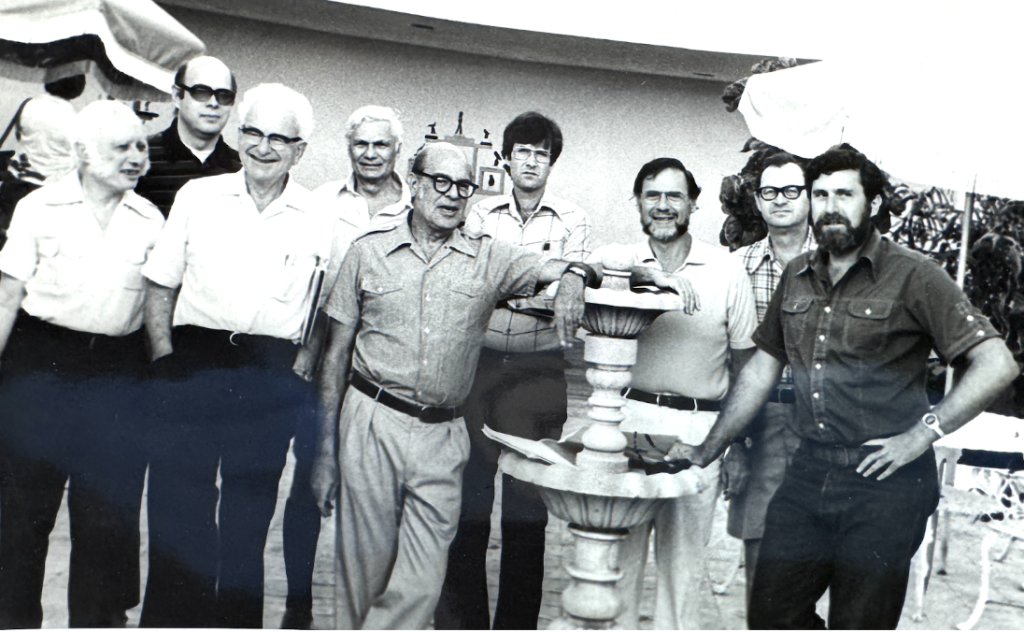
A decade after the housing study, Leon Festinger introduced his best known contribution to social science in A Theory of Cognitive Dissonance, proposing that individuals seek to resolve the discomfort of encountering conflicting attitudes and beliefs– a disposition that might contribute to our society’s polarization. Frank Harary, also at RCGD, made important contributions to the theory, demonstrating that avoiding conflict causes networks to self-organize into polarized groups, or “echo chambers.” Harary and former RCGD director Dorwin Cartright built on the foundations of social networks by focusing on the notion of balance as a factor in group stability. Mathematician Anatol Rapoport of the University of Michigan’s former Mental Health Research Institute, known for his work on the “prisoner’s dilemma,” made further contributions in early network theory with his work on random graphs and experimental social network analysis involving Ann Arbor schools.
Social scientists at the University of Michigan have more recently applied social network analysis to the studies of voting behavior, the spread of misinformation, and partner selection in online dating. It’s used to identify social media influencers that may impact health behaviors, like vaccine uptake, and to understand animal interactions, including findings presented in the RCGD seminar series on how wasps evaluate rivals. The Institute for Social Research continues to lead in advancing new methodologies in social science, and this is facilitated by its own spider-webbed network of scholars influencing one another across disciplines, nations, and generations.
For public benefit, social network analysis can provide useful maps that show what we’re exposed to, who influences whom, and also what we may be missing; they may suggest how groups divide, but also how they come together. They might give us hope about the influence mere individuals can have with small, meaningful actions that reverberate through what Grace Lee Boggs called the “invisible fabric of our connectedness.” They may also reveal the boundaries and gaps in our connections and suggest the perils of confining our worlds to paths curated by algorithms or limited to our own social cliques. We can literally structure our environments in ways that foster or inhibit meaningful connection. A told B, and B told C, but there’s even more there beyond the coconut tree.
This post was written by Tevah Platt, communications manager for the Research Center for Group Dynamics, which advances the study of human behavior in social contexts. Tevah lives in the Great Oak co-housing community in Ann Arbor intentionally designed to support social connection, including Westgate-style, horse-shoe arrangements around courtyards. RCGD’s seminar series runs Mondays at 3:30 ET at the Institute for Social Research; this semester’s series is “The Ties that Bind: Interdisciplinary Perspectives on Social Connection.”
We gratefully acknowledge contributions from Mark Newman and Rich Gonzalez, archival assistance from Madeleine Bradford, Meg McKenzie, and Sophia Grant of the Bentley Historical Library, and permissions assistance from Deborah Shaddy of the American Society of Group Psychotherapy and Psychodrama.
Sources and Further Reading:
Borgatti, Stephen P., Ajay Mehra, Daniel J. Brass, and Giuseppe Labianca. “Network Analysis in the Social Sciences,” in Science 323:5916. 2009.
Borrman, Kristina. (2022). “Studying Friendship in Housing the MIT School of Architecture at MIT in the Postwar Years,” in Journal of Urban History, 48(5) 1100-1120.
Ernste, Thomas. (2014). The networked gatekeeping process for news in the 21st century. 2014 International Conference on Collaboration Technologies and Systems, CTS 2014. 11-18.
Festinger, L., Schachter, S., & Back, K. (1950). Social pressures in informal groups: A study of human factors in housing. Harper & Brothers.
Festinger, L. (1949). “The analysis of sociograms using matrix algebra.” Human Relations, 2, 153–158.
Festinger, L. (1957). A Theory of Cognitive Dissonance. Stanford University Press.
Martin, Bill, Jr., and John Archambault. Chicka Chicka Boom Boom. Illustrated by Lois Ehlert. New York: Simon & Schuster Books for Young Readers, 1989.
Newman, Mark. Networks: An Introduction. Oxford: Oxford University Press, 2010.