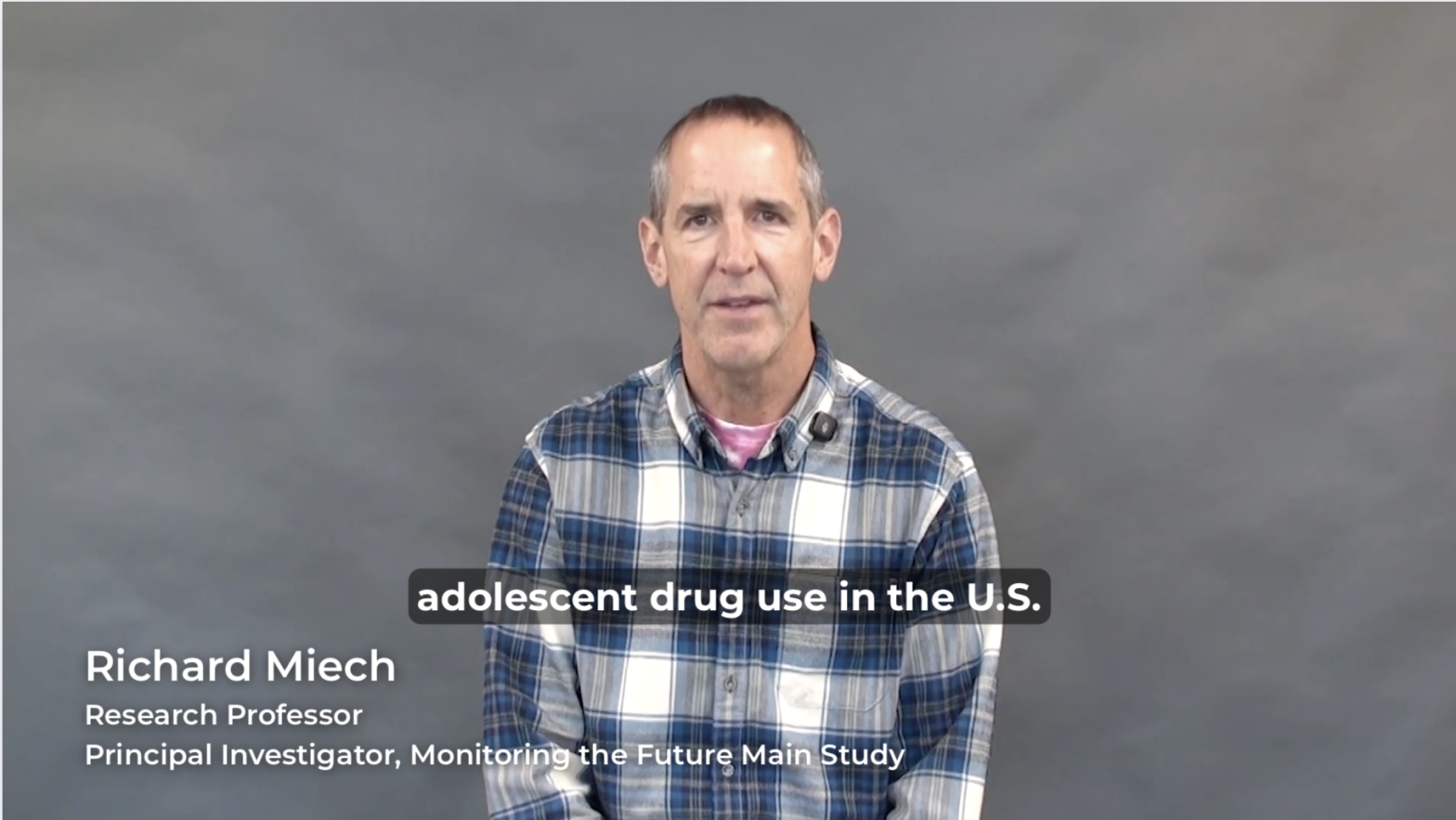
In this video, Richard Miech, research professor in the Survey Research Center and the Principal Investigator of the Monitoring the Future (MTF) main study, discusses recent trends in adolescent drug use.
In 2020, during the early days of the pandemic, adolescent drug use in the U.S. dropped more sharply than ever before recorded. These drops were for the three most commonly used drugs of alcohol, cannabis, and vaped nicotine. And for almost all other drugs as well.
At the time, many experts expected those declines to bounce back once social distancing eased and life returned to normal. Including me!
But that rebound never happened. Data from the Monitoring the Future study, a long-running study of the behaviors and values of American adolescents, show that teen drug use continued to decline through 2024, building on the unprecedented drops we first saw in 2020.
It’s a surprising and important trend. And it’s exactly why long-term studies like Monitoring the Future are so essential to our understanding of teen substance use.
Our project tracks national trends among U.S. teens by surveying students in classrooms each year from a rotating sample of about 300 schools, scientifically selected to represent the nation as a whole. Because of this rigorous design, our annual findings closely mirror what we would see if every student in the United States were surveyed—accurate within just a percentage point or two.
The results from Monitoring the Future help shape national policy and inform schools and communities, shedding light on teens’ actual behaviors and clearing up misconceptions.
For example, when schools get their own data back, students often realize that far fewer of their peers are using drugs than they thought. That simple awareness can help shift social norms, and reduce pressure to use.
We are one of the few studies that can directly compare teen drug use before and after the pandemic because we used the same survey method the whole time. When schools closed in 2020 and 2021, the only way to reach students was online. Luckily, we had already switched to electronic surveys in 2019, just before the pandemic, so our results are consistent and comparable year to year.
Monitoring the Future doesn’t just document trends. It helps explain them, and equips educators, researchers, and policymakers with the tools they need to respond and shape a healthier future.