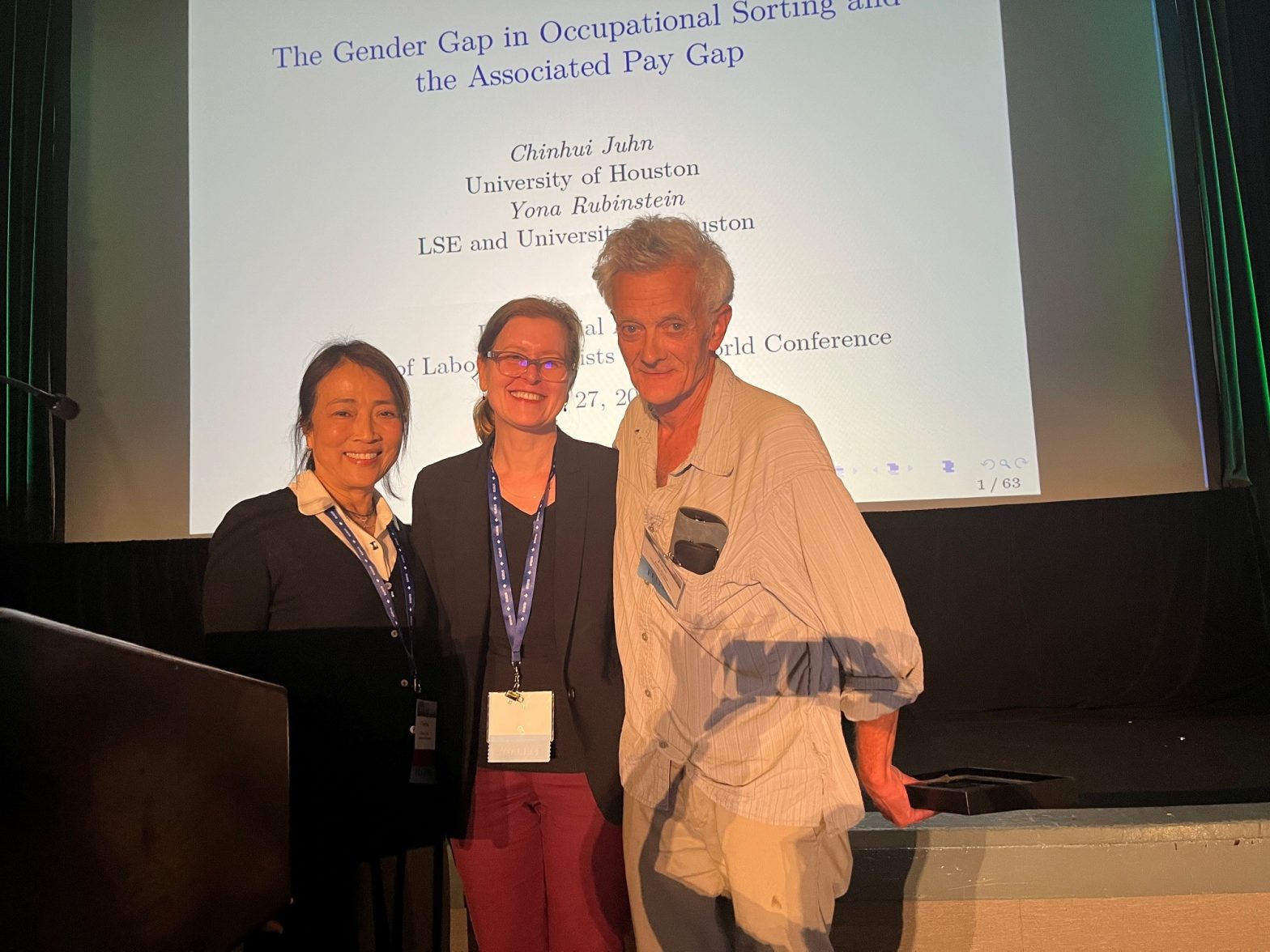
Professor Emeritus John Bound, Emeritus Research Professor with the Population Studies Center at the University of Michigan Institute for Social Research, has received the 2025 Jacob Mincer Award from the Society of Labor Economists. The Jacob Mincer Award recognizes one individual each year for “lifetime contributions to the field of labor economics.” Professor Emeritus Bound was specifically cited for his work on disability and his “great methodological diversity.”
Bound was recognized for making fundamental contributions to labor economics across many substantive areas including inequality, Black-white income gaps, education, and disability. To award committee noted that his work is distinguished by great methodological diversity focusing on measurement, documenting new facts about the world, as well as the estimation of structural models.
“Two characteristics of John’s thinking are evident in all his work,” the awards committee wrote. “First, he endeavors to use economic models to understand the data, and second, he is deeply skeptical and takes nothing for granted.”
Bound played a pivotal role in the literature on changes in the wage structure change in the 1980s, providing evidence implicating skill-biased technical change (Bound and Johnson, 1992; Berman, Bound, and Griliches, 1994, and Berman, Bound, and Machin, 1998).
He also advanced the study of disability, pioneering the idea of using unsuccessful applicants as a control group for successful applicants in order to study the labor supply effects of disability insurance (Bound, 1989). This approach, which anticipates the use of “judge” instruments, is still in use. His work on the interpretation of survey responses (Bound, 1991) has had a huge impact on the disability literature, as has his work on the implications of changes in the generosity of disability benefits (Bound, Cullen, Nichols, & Schmidt, 2004). Some of his work on disability is summarized in “Economic Analysis of Transfer Programs Targeted on Persons with Disabilities” (Handbook of Labor Economics, 1999).
His work on mobility, both within the United States and internationally, shows that it is key to understanding higher education trends (e.g., Bound, Groen, Kezdi, and Turner (2004), Bound, Braga, Golden, and Khanna (2015), Bound, Braga, Khanna, and Turner (2021)).
Bound also documented increases in the time to a baccalaureate degree (Bound, Lovenheim, and Turner (2010)), which subsequently reversed. Some of this work on the determinants of college education appear in his chapter in the Handbook of the Economics of Education, “Dropouts and Diplomas: The Divergence in Collegiate Outcomes” (2011).
In work with Arline Geronimus, also a PSC affiliate, he has studied Black-white differences in health. This work supports the idea that the stressful lives of Black people in the United States cause them to age more quickly than white people (e.g., Geronimus, Hicken, Keene, and Bound (2006)). This finding provides an important perspective on gaps in the situations of Blacks and Whites in the labor market.
In terms of methods, he is perhaps most famous for his early contributions to the literature on weak instruments (Bound, Baker and Jaeger, 1995). But he has made other thoughtful and influential contributions to methods including his work on measurement error (Bound and Krueger 1991, “Measurement Error in Survey Data” (Handbook of Econometrics, 2001), and going beyond the Oaxaca-Blinder-Kitagawa decomposition to understand the Black-white wealth gap (Barsky, Bound, Charles and Lupton, 2002).
“John Bound’s contributions have enriched academic discourse and provided valuable policy insights,” the committee wrote. “John has been an exceptionally dedicated doctoral advisor. Many of his students have had distinguished careers in research, teaching, and public service. His research continues to shape our understanding of labor markets, education, and disability policy. He has profoundly influenced the field of labor economics with his pragmatic approach to observing, measuring, and analyzing the social factors that influence the labor market.”
Professor Emeritus Bound joined the Michigan Department of Economics in 1986. He has been an Elected Fellow of the Society of Labor Economists since 2006 and has also held positions in the National Bureau of Economic Research. At Michigan, he has served in multiple different leadership positions within the department and taught countless students.
Four former winners (Gary Becker, James Heckman, Claudia Goldin and David Card) have gone on to win the Nobel prize in economics. Bob Willis also won the prize in 2015.
Contact: Tevah Platt, Population Studies Center
This post includes reporting from LSA’s Connor Zahler and language from the SOLE announcement.